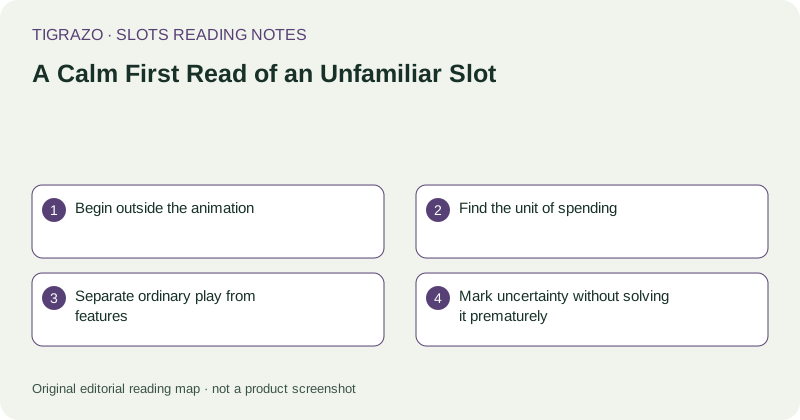
Begin outside the animation
Read the game information before treating the main screen as an explanation. A symbol flashing across several reels may be decorative, part of a completed result, or an invitation to open another panel. None of those possibilities tells you the full payment rule. Look first for the basic format: reels and lines, adjacent reels, clusters, or another arrangement described in the rules.
Write one sentence identifying how a standard win forms. If that sentence requires several guesses, keep reading rather than filling the gaps with assumptions from another game.
Find the unit of spending
Locate the total stake for one complete paid round. A coin value, line amount, or multiplier may be only one component of that total. Check whether optional settings change the amount charged and whether a displayed prize is expressed in currency, credits, or multiples of stake.
A hypothetical example makes the distinction clear: twenty lines at 0.02 units per line create a total stake of 0.40 units. A prize described as five times total stake would then be 2.00 units, not five times each separate line amount unless the rules explicitly say so.
Separate ordinary play from features
Identify the symbols and conditions that start a feature. Then read the feature's own rules. A wild may substitute in the base game but behave differently in a special round. A scatter can have a triggering role without paying an ordinary line win.
- What event starts the feature?
- Does it require a particular symbol position or quantity?
- Can its duration or multiplier change?
- Are any displayed prizes subject to separate conditions?
Mark uncertainty without solving it prematurely
Use a small list headed clear, unclear, and not stated. Put an explicit rule under clear; put an ambiguous interpretation under unclear. Information absent from the panel belongs under not stated. This distinction prevents a neat notebook from giving uncertain claims an appearance of certainty.
Do not infer volatility from a dramatic introduction or expected return from one appealing prize. These describe different aspects of the game and require different information.
Finish with a reading decision
A useful first read can end with a decision not to continue. Perhaps the stake controls remain confusing, the payment arrangement is difficult to follow, or the feature rules demand more attention than you want to give. Understanding your own limit is a complete outcome. Save the unanswered question, close the panel, and return only if understanding it still serves a purpose.