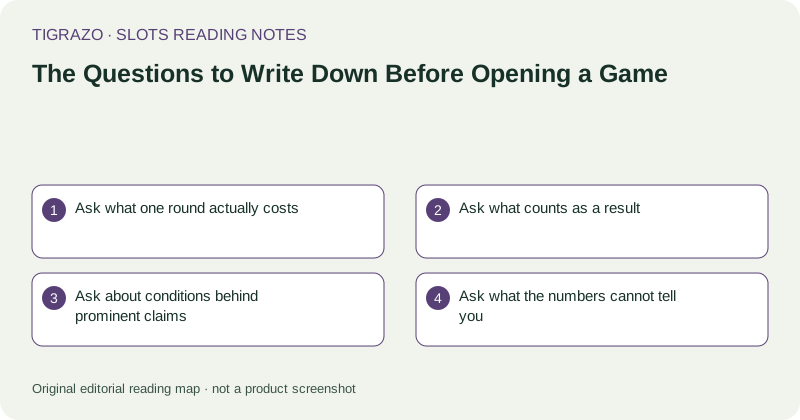
Ask what one round actually costs
The first question should concern the total amount charged for a paid round. Games can display coin values, line settings, denomination choices, or optional additions. A number beside a plus button is not necessarily the complete price. Your question should be precise enough to resolve that ambiguity: what balance deduction follows one ordinary activation at the selected settings?
Add a second question about whether any optional mode changes that deduction. Keeping these separate makes a setting change visible rather than burying it inside a general note about stakes.
Ask what counts as a result
Write down how a standard paying combination forms and which direction or spatial arrangement matters. Matching symbols may need to occupy consecutive reels, a specified line, or a connected group. A game that resembles something familiar may still use a different rule.
Then ask which symbols are exceptions. Wilds, scatters, collectors, and special markers need their own definitions. Their names are labels, not complete explanations of their behaviour.
Ask about conditions behind prominent claims
A large prize label deserves a question rather than an immediate conclusion. Is it a maximum possible award, a fixed prize, or a changing jackpot? What stake basis is used? Is the displayed figure available under every setting, or does eligibility depend on an expressly stated condition?
- Where is the claim defined in the rules?
- Which settings or events qualify?
- Is the figure a ceiling rather than a typical outcome?
- Does the wording identify the relevant game version?
Ask what the numbers cannot tell you
If RTP is supplied, ask whether you understand its scope. It represents long-run expected return over wager volume, not a refund percentage for your next session. If volatility is described, ask whether that description is defined or merely promotional shorthand. Neither statistic predicts the next result.
A hypothetical 96% RTP applied to 100 units of total wagers corresponds to an expected return of 96 units across the mathematical model. It does not say a particular person will finish four units down.
Ask when the reading ends
Include a personal boundary: how much time will you spend resolving these questions, and what uncertainty would make you stop? You do not need to complete every rules panel as an intellectual challenge. A workable final note might say that payment structure is clear but feature eligibility remains unresolved. That is a reason to pause, not an invitation to spend money discovering the answer experimentally.