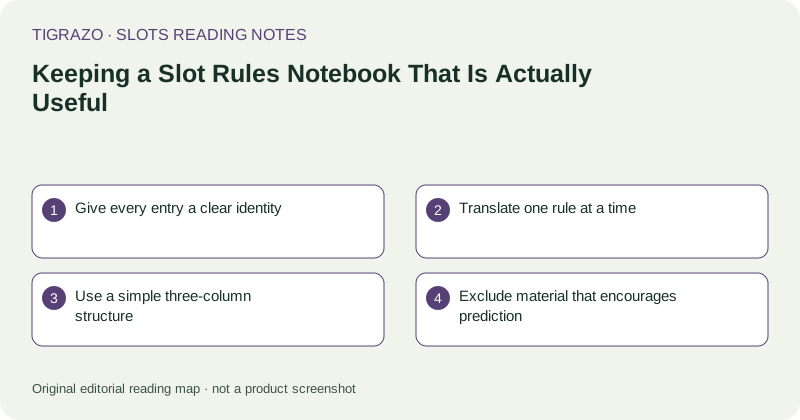
Give every entry a clear identity
Begin with the displayed game name, the date of reading, and any version or configuration information actually available. Do not invent missing identifiers. If an RTP setting is shown, record it exactly; if it is absent, write not shown. Two similarly named presentations need not share every mathematical setting.
Record the stake basis used in your examples. A payout multiple becomes hard to interpret later if the notebook never says whether it refers to total stake, a line stake, or another defined unit.
Translate one rule at a time
Keep the original idea and your interpretation close together. For example, a rule requiring matching symbols on successive reels from the left can become: start at the leftmost reel and count uninterrupted matching positions according to the listed arrangement. This preserves direction and continuity instead of reducing the rule to match symbols.
Use a separate entry for exceptions. A wild that excludes a special symbol should not disappear into a broad sentence saying wilds replace everything.
Use a simple three-column structure
| Topic | Plain-language note | Open question |
|---|---|---|
| Stake | Total round cost appears in the main control | Does an optional mode alter it? |
| Scatter | Trigger quantity is defined separately | Does position matter? |
| Prize display | Some values use stake multiples | Which stake unit applies? |
This is a reading framework, not a claim about any particular game. Replace each example with a verified statement or leave it unresolved. Empty certainty is less useful than a clearly labelled question.
Exclude material that encourages prediction
A sequence of recent wins and losses does not explain the payment rules. If independently determined spins are involved, a losing streak does not make a win due. Mixing streak observations into a rules notebook can quietly turn a reference document into a search for patterns.
Keep any spending record separate and factual. Its purpose is to show costs and limits, not to identify moments when the game supposedly becomes favourable.
Review for usefulness, not completeness
After a reading, ask whether another person could reconstruct the main payment rule from your notes. Remove decorative descriptions that obscure the answer. Keep unresolved questions near the top so they cannot be mistaken for settled facts.
Archive entries that no longer match the version you can identify. A notebook earns its place by reducing confusion on the next reading, not by accumulating pages or demonstrating how many games you have examined.