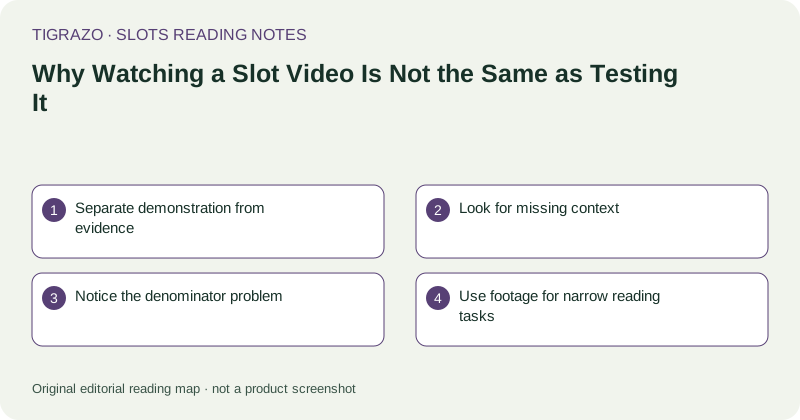
Separate demonstration from evidence
A clear recording may help you recognise a symbol, follow the stages of a feature, or locate an information button. Those are observational benefits. The same recording does not establish typical returns, the probability of a rare result, or how comfortable the interface will feel on your device.
Even unedited footage is a finite sample. Editing adds another selection layer, but removing edits does not turn a short session into a reliable measurement of the game's full outcome distribution.
Look for missing context
Check whether the video identifies the stake, version, relevant configuration, and whether play uses a demonstration balance or real money. If those details are absent, avoid supplying them from appearance. Similar interfaces can display different settings.
A video may also omit the rules panel, the session's beginning, or the amount wagered between notable results. Without that context, a sequence of exciting clips says little about the cost or frequency of what is shown.
Notice the denominator problem
A compilation can display ten large awards without saying how many rounds were considered to find them. The missing denominator prevents a frequency estimate. Ten events out of one hundred rounds and ten out of one million rounds are very different observations.
Those figures are hypothetical illustrations, not estimates for any game. The point is that counting visible highlights cannot establish probability when the selection process and total sample are unknown.
Use footage for narrow reading tasks
- Observe how a defined feature is presented.
- Check whether important information remains visible during animations.
- Note terminology to verify in the current rules.
- List questions the recording does not answer.
Do not call a visible near miss proof that a feature was almost due. The arrangement shown is an outcome, not a forecast. Similarly, an impressive award does not validate a staking method or demonstrate that higher spending improves the underlying odds.
Keep your conclusion proportional
A responsible note might say that the footage illustrates a feature sequence but leaves its trigger probability and current eligibility conditions unknown. That is more useful than either dismissing every video or treating one as a complete review.
Direct inspection of current rules can answer some remaining questions, while others may remain unavailable. You do not need to move into paid play to settle them. The distinction between watching and testing is ultimately about limits: a recording can show what happened in the footage, but not promise what will happen to you.