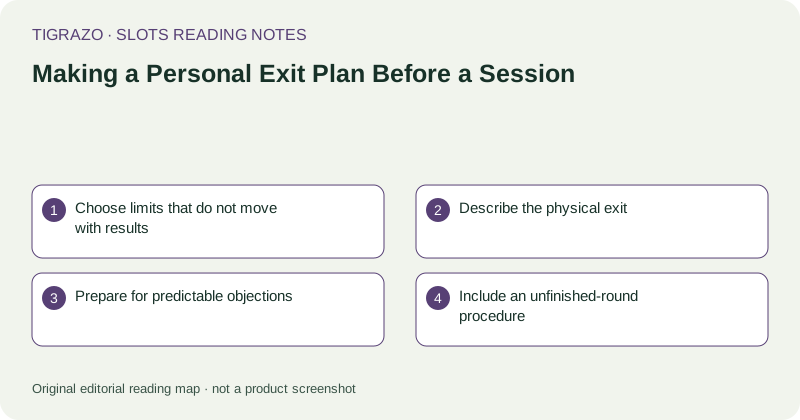
Choose limits that do not move with results
Set a spending boundary and a time boundary before starting. Decide that whichever arrives first ends new paid play. Neither should rely on winning back a loss, using a remaining balance, or seeing a particular animation. Those conditions give the game, rather than your plan, control of the endpoint.
Record the limits in ordinary language. A sentence such as no more paid rounds after the planned time is easier to apply than an intention to stop when it feels right.
Describe the physical exit
Specify what you will actually do after the final completed round. Close the game, leave the gambling page, and begin another activity. If remaining on the same screen invites reconsideration, make the next activity visibly different: preparing food, taking a walk, or reading something unrelated.
The replacement activity is not a reward for a good result. It is simply the next part of the day, available whether the session ends ahead, behind, or unchanged.
Prepare for predictable objections
Write a response to the reasons you are most likely to give for extending play. A feature that has not arrived is not owed. A near miss does not make an independent next spin more likely to win. A recent award does not invalidate the time boundary.
| Thought | Planned response |
|---|---|
| I should recover this loss | The limit includes the possibility of losing |
| I want a satisfying ending | Stopping as planned is the ending |
| One more feature would finish it | No feature is required to leave |
Include an unfinished-round procedure
An apparent technical issue should lead to documentation, not a new spending decision. Record the time, stake, round identifier if available, and any message. Use round history or the appropriate support route to establish the recorded outcome.
Do not repeatedly reload or add funds to force an answer. If clarification takes time, your session can still end while the question remains open. Keep the issue separate from any urge to continue.
Review the plan after leaving
Later, note whether the boundary was followed and which practical step helped. If the plan repeatedly fails, make access easier to limit through available account controls or take a longer break. Appropriate gambling support can help when stopping feels difficult.
The plan is not a promise that gambling will feel comfortable. It is a way to protect your ability to leave. A useful review therefore measures whether you retained that choice, not whether the final balance made the session feel worthwhile.