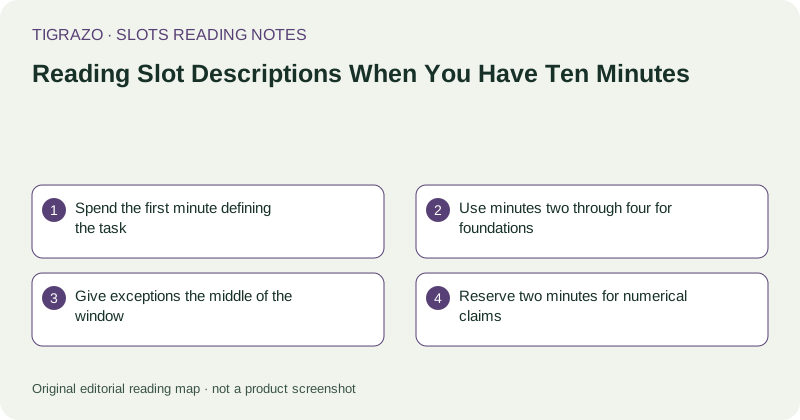
Spend the first minute defining the task
Open the information panel and decide what you need to learn. A workable objective is to understand the total cost of one paid round, how ordinary wins form, and where the major exceptions live. Do not begin by watching repeated animations and hoping the rules will become obvious.
Keep a simple note with three headings: known, unclear, and optional reading. This gives unfamiliar terminology somewhere to go without interrupting the whole reading process.
Use minutes two through four for foundations
Find the total stake and the unit used in the paytable. Then establish the payment arrangement: lines, adjacent reels, clusters, or another explicitly described structure. Note direction, minimum quantities, and whether several awards can occur in one round.
If the cost is expressed through several components, calculate a small hypothetical example. Ten lines at 0.03 units per line would total 0.30 units. This arithmetic checks your interpretation; it does not estimate what a session will return.
Give exceptions the middle of the window
Use the next three minutes to identify wilds, scatters, feature triggers, and special prize conditions. Read definitions before promotional summaries. A feature name can sound descriptive while leaving its actual requirements unstated.
- Does a special symbol substitute, pay, trigger, or collect?
- Can one symbol have several roles?
- Do feature rules change the ordinary payment arrangement?
- Are prominent prize amounts conditional?
Do not force every detail into memory. Record the main exception and the place in the rules where its full explanation appears.
Reserve two minutes for numerical claims
Check any displayed RTP and its configuration context. RTP describes long-run expected return over wager volume, not the percentage you personally receive back. A volatility label concerns the distribution of outcomes and does not predict the next spin. Hit frequency, when defined, is another separate measure.
If a statistic is missing, label it missing. Ten minutes does not create permission to infer a number from a theme, popularity claim, or short video.
Use the last minute to decide what remains
Write a two-sentence summary: how an ordinary win forms, and what you still cannot explain. Then stop the reading window. If a critical point remains unclear, that is your result, not a failure of concentration.
A time-boxed method should make it easier to leave, not create pressure to move from incomplete understanding into paid play. You can return to a precise question later, or decide that the game requires more reading than you want to undertake.