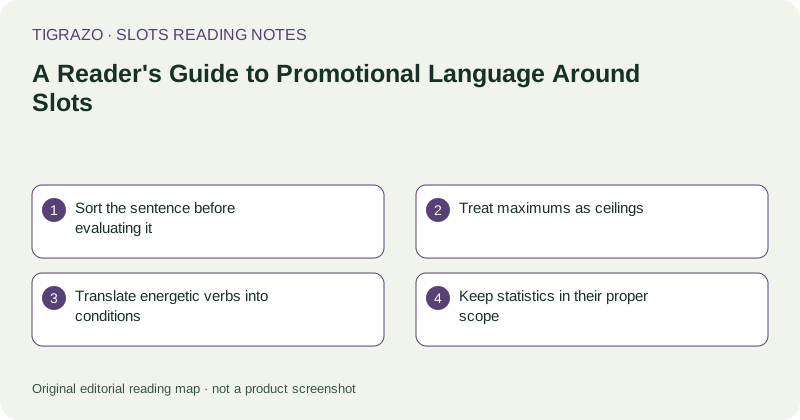
Sort the sentence before evaluating it
Start by asking what kind of statement you are reading. A phrase about an exciting adventure expresses mood. A claim about a maximum award describes a ceiling. An RTP figure describes a mathematical expectation over large wager volume. A feature summary describes a rule only if its conditions are sufficiently clear.
Putting all four into one mental category called benefits makes comparison difficult. Each needs a different question, and some cannot answer anything about likely personal outcomes.
Treat maximums as ceilings
A large top prize tells you what may be possible under the defined conditions, not what is common or expected. Check whether the figure uses currency or stake multiples, whether it includes several parts of a round, and whether eligibility varies by setting.
A hypothetical maximum of 5,000 times total stake would equal 1,000 units at a 0.20-unit stake. That calculation translates the label only. Without probability information, it says nothing about how often the maximum occurs or whether a session is likely to approach it.
Translate energetic verbs into conditions
Words such as unlock, collect, boost, and unleash can describe real mechanics, but they do not specify those mechanics by themselves. Find the corresponding rule: how many symbols, in which positions, under what circumstances, and with what effect?
- Replace frequent with a defined frequency, if one is supplied.
- Replace huge with a numerical amount and unit.
- Replace enhanced with the setting that changes and its cost.
- Replace rewarding with the exact award rule, if available.
Keep statistics in their proper scope
RTP is long-run expected return relative to wager volume; it is not a guarantee that a player recovers the stated percentage. Hit frequency can include awards smaller than the stake, depending on its definition. A volatility description concerns variation, not a promise of either rapid wins or eventual recovery.
When a promotional description blurs those distinctions, restore them in your notes. Do not interpret a claim about one measure as evidence for another.
Notice what the wording leaves open
An absent condition is not automatically a favourable condition. If a sentence does not explain eligibility, costs, limits, or the relevant version, mark the issue unresolved and consult the rules. Repetition across several descriptions does not make a claim more precise.
Your final note can be restrained: appealing theme, clearly stated trigger, unclear prize basis. That style preserves useful information while refusing to let enthusiasm perform the work of an explanation.