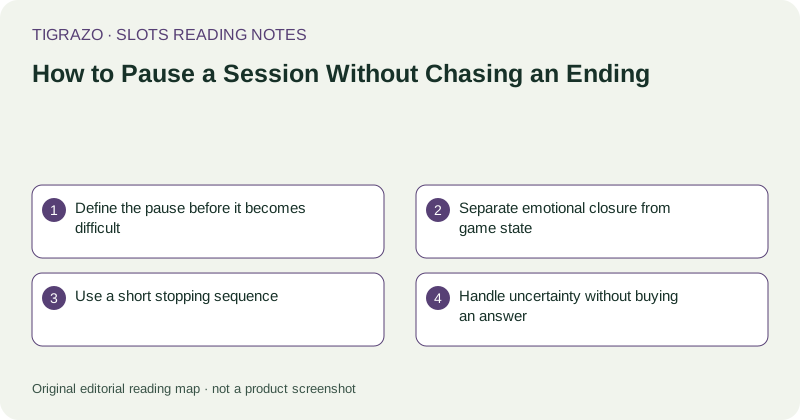
Define the pause before it becomes difficult
Choose a time or spending boundary before beginning, while the decision is relatively detached from recent results. Write down what reaching it means in practical terms: no new paid rounds, a brief factual note, and leaving the game. Avoid a condition such as stop after a decent win, because the game cannot promise when that condition will occur.
A boundary is useful when it can be recognised without negotiation. A vague intention to be sensible leaves too much room for reinterpretation during an absorbing activity.
Separate emotional closure from game state
Near misses, an untriggered feature, or a run of losses can create a sense that something remains to be completed. They do not establish that a favourable result is approaching. In independently determined play, previous outcomes do not make the next spin due to repair the session.
Some games contain persistent meters or continuing features with expressly defined rules. Read those rules, but do not treat a visible unfinished element as an obligation to keep spending. It is still possible to stop.
Use a short stopping sequence
- Finish observing any round already in progress.
- Do not start another paid round to create a nicer final result.
- Record the time, balance information, and any unresolved issue factually.
- Close the game or leave the gambling environment.
- Move to an unrelated activity that does not invite immediate reconsideration.
The sequence works because each action has an observable endpoint. It does not depend on feeling pleased with the last result. Disappointment can remain present without becoming an instruction to continue.
Handle uncertainty without buying an answer
If a round appears incomplete or the balance looks wrong, note the displayed time, round identifier if available, stake, and relevant message. Consult recorded round history or the appropriate support route. Do not repeatedly reload, redeposit, or initiate more play to test whether the problem resolves itself.
A technical question belongs in a verification process. It should not become a reason to extend a session beyond its boundary.
Read the pause note later
When you return to your notes outside the session, ask whether stopping felt like breaking a promise to yourself or fulfilling one. The useful promise concerns your boundary, not the game's next result.
If you repeatedly find yourself extending play to recover losses or obtain closure, take a longer break and consider available gambling support or account limits. The point of the pause is to preserve choice, not to manufacture a more satisfying final spin.