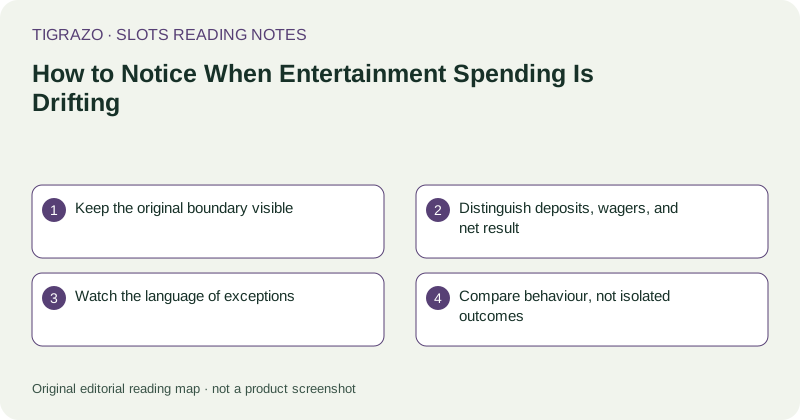
Keep the original boundary visible
Write the intended entertainment amount and time limit before the session. Use money that is genuinely available after essential commitments, and do not treat access to additional funds as part of the plan. The boundary should describe what you can comfortably spend, not what you hope to win.
When the original note remains visible, later changes can be recognised as changes. Without it, a revised limit can start to feel like the limit you always meant to use.
Distinguish deposits, wagers, and net result
A deposit is money moved into an account. Wager volume is the sum of stakes placed, including money that may be wagered again after an award. Net result is the difference between relevant starting funds, additions, withdrawals, and ending funds. These measures answer different questions.
In a hypothetical session, starting with 20 units and finishing with 14 units after no additions or withdrawals means a net loss of 6 units. If sixty rounds each cost 0.50 units, wager volume is 30 units. Neither figure should be substituted for the other.
Watch the language of exceptions
Drift often arrives in phrases such as just until the next feature, only one more deposit, or the higher stake will make this worthwhile. These phrases move the endpoint away from an observable boundary and toward a hoped-for result.
- Has the permitted time changed more than once?
- Has a loss become a reason to increase spending?
- Are wins being used to excuse a broken limit?
- Are records becoming less exact as spending increases?
Compare behaviour, not isolated outcomes
A winning session does not establish that a spending pattern is sustainable. Equally, an ordinary loss within a firm boundary does not by itself indicate drift. Focus on whether your decisions stayed consistent with your prior limit and whether gambling is displacing other needs.
Review several entries outside the gambling environment. Look for repeated extensions, unplanned transfers, or discomfort when stopping. These behavioural observations are more useful than trying to infer a trend in the game's outcomes.
Respond by reducing access and pressure
If drift is visible, pause and restore a clear boundary before considering any further play. Available deposit limits, time controls, or a longer exclusion can support that decision. Do not attempt to repair the record by winning back money.
If stopping or keeping limits has become difficult, seek appropriate gambling support. The purpose of noticing drift is to protect your choices and finances early, not to produce a more elaborate system for continuing.